Under the Napoleonic Eagle: New Orders, New Designs, New Classes
by Tom Bergroth and Catherine Lapinsh
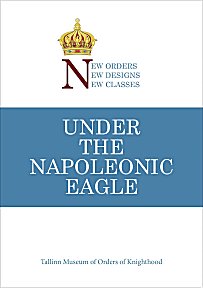
This fascinating little book, marketed as the catalogue for an exhibition of the same name at the Tallinn Museum of Orders of Knighthood in 2025, details in magnificent detail a seminal period in the development of orders of knighthood when, with the French Legion of Honour as an exemplar, orders moved from something shared between monarchs and their cronies to a system of reward for any citizen, based on merit alone. As the French empire spread, the creation of vassal states required the establishment of their own awards while its influence spread wider yet inspiring other nations to reconfigure and expand existing orders and institute new ones, providing a solid foundation whose influence can be seen even to this day.
It starts, of course, with Napoleon himself. His early rise during the French Revolution and subsequent establishment of a French Empire are documented, showing how principles of democracy and freedom survived the transition to Empire and even his dictatorial style of government. Laws gave each citizen clearly defined rights and responsibilities, government posts were earned by individual merit rather than birth or patronage, and education became more widely available. While things were not perfect it was a great improvement on what had gone before.
As the bounds of the Empire expanded, new vassal states were formed by conquest or treaty. Most were entrusted to rulers who were either Napoleon's relatives or members of his inner circle. At the height of the Empire in 1810, some seven European states were under close control of Napoleon, with a further three acting as allies, and others neutral but somewhat influenced by him. This all sets the scene for the institution of new orders to serve the needs of these states and their rulers.
The model was the Legion of Honour, instituted by Napoleon in his role as First Consul of the Republic on 19 May 1802. This developed quite slowly, it took two years before the new order had any insignia for its membership to wear, originally in four classes with the fifth - which went through several changes of name before settling on "Grand Cross" - being added in 1805. From the outset the design was the familiar five-armed white-enamelled cross with a gold centre surrounded by a blue ring and worn on a red ribbon, although it has gone through many changes since, with four versions during Napoleon's time as First Consul and Emperor alone. The seminal effect of this new style of order can be seen in Denmark, where the Order of the Dannebrog - which had been a single-class order since its institution in 1671 - was converted to a multi-class order in 1808.
Other orders were also established, such as the Order of the Reunion (1811) for administrators, the judiciary, and military personnel for services within France and annexed nations and the Order of the Iron Crown, which was instituted in 1805 to mark Napoleon's coronation as King of Italy, using the Iron Crown of Lombardy for the purpose. This Order of the Iron Crown ceased to exist in 1814 but was picked up by the Emperor of Austria the following year as a new Austrian order, the Imperial Order of the Crown.
Meanwhile the short-lived Kingdom of Holland, bestowed on Napoleon's brother Louis, started off with two orders instituted in 1806 - the Order of the Union and the Royal Order of Merit - but these were amalgamated the following year to form the Royal Order of Holland, later renamed the Royal Order of the Union and abolished in 1811 when Napoleon replaced it with the Order of the Reunion. Every change occasioned alterations in the insignia, which will give me nightmares trying to sort this all out on my website!
There are also notes on the Kingdom of Naples, the Kingdom of the Two Sicilies, and the Kingdom of Spain - which oscillated between being an ally and an enemy of France during the Napoleonic period are also discussed, along with the Kingdom of Westphalia, carved out of several German states, along with the orders established therein, again often short-lived and with changes of insignia mirroring changes within the states themselves.
Other states were also inspired by these examples to produce new orders or modify existing ones, such as the Grand Duchy of Baden (which on deciding that they needed an army, also required an order with which to reward them!), the Grand Duchy of Württemberg (which was ruled by the same individual, Ferdinand, as the Grand Duchy of Tuscany, who on losing Württemberg took the order he'd invented with him), and the Kingdom of Bavaria.
Throughout, there are numerous illustrations chiefly of the insignia of the orders discussed but also many portraits of the various rulers - needless to say, bedecked in the orders they had invented and/or received. As well as casting a new light on a convoluted period of history as viewed through the honours of many of the nations involved, this work is a visual treat with many seldom-seen insignia on display, drawing on the collections of the Tallinn Museum of Orders of Knighthood and the Museum of the Legion of Honour.
This seminal period of phaleristic history also saw a rise in the use of orders as a means of cementing relationships between states and as well as the creation of new orders, the development of decorations of bravery to be awarded to individuals for their actions on the field of battle such as the Russian St George Cross (1807), the Austrian Cannon Cross, and the first Iron Cross from the Kingdom of Prussia (1814). Rounding off with technical data on the sizes and composition of various orders depicted here along with details of manufactures and hallmarks, this is a delight to the eyes as well as extremely informative.
You can get a copy from the Museum here.
Page last updated: 24 October 2026